Commercial Concrete Solutions for NRH Businesses
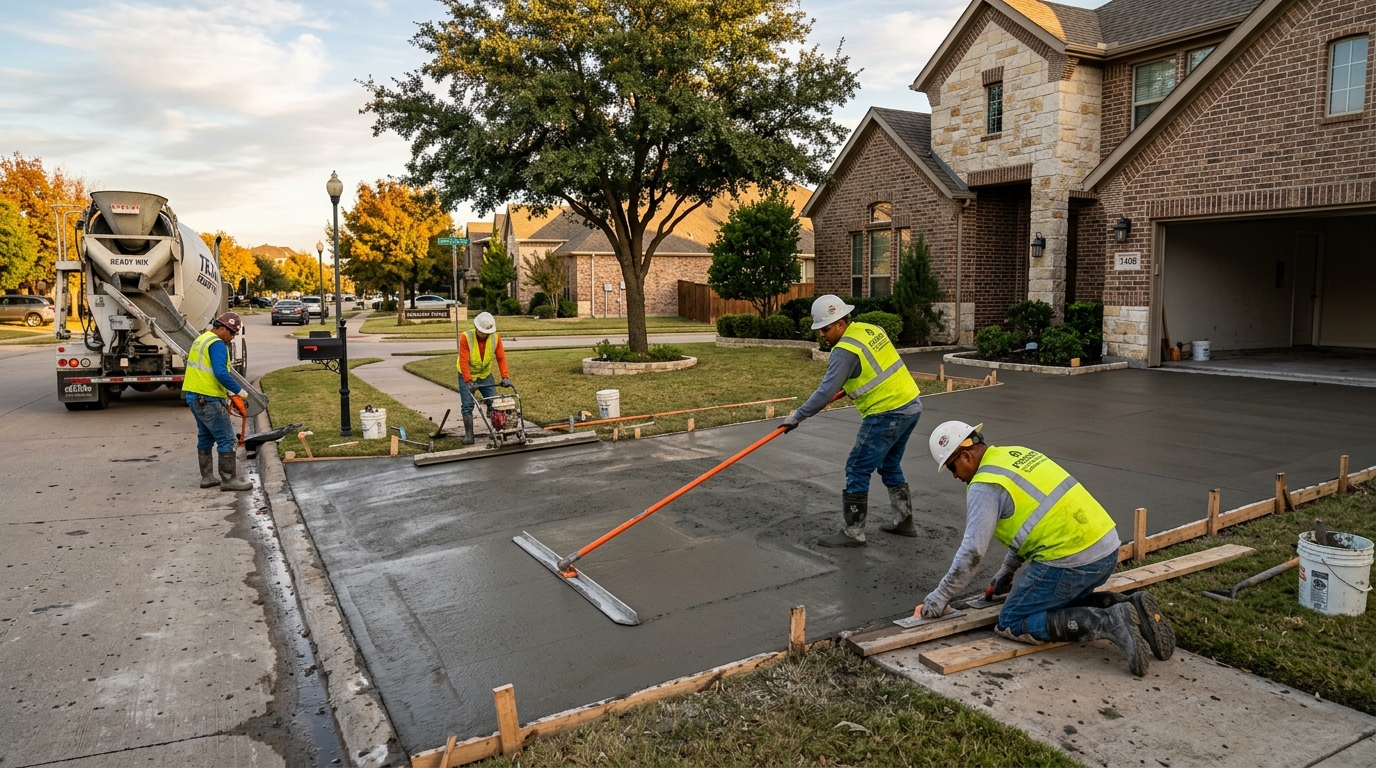
Commercial concrete needs in North Richland Hills are driven by the city’s active business corridors along Loop 820, Davis Boulevard, and Precinct Line Road. Property owners and managers in these corridors face concrete challenges specific to high-traffic commercial environments: parking surfaces that must withstand daily vehicle loads, ADA compliance requirements for accessible routes and ramps, and the same expansive clay soil conditions that affect residential concrete — at commercial scale, where a failed parking surface means liability exposure and immediate maintenance costs.
In this post, we will cover the types of commercial concrete work most common in NRH, the code and ADA requirements that apply, how commercial concrete specifications differ from residential work, and what the permit process looks like for commercial projects.
Commercial Concrete for NRH Businesses — Free Estimate
North Richland Hills Concrete Pros serves commercial clients throughout Tarrant County. Call (888) 376-0955.
The NRH Commercial Concrete Landscape
North Richland Hills’ commercial activity centers on several distinct corridors:
Loop 820 (Northeast Loop 820) is the primary commercial artery — retail centers, restaurants, auto services, and light industrial facilities line both sides. Concrete needs here include parking lots, drive approaches, equipment pads, and loading areas.
Davis Boulevard (FM 1938) is NRH’s major north-south retail corridor — grocery-anchored shopping centers, medical offices, restaurants, and service businesses generate steady demand for parking lot maintenance and ADA improvement projects.
Precinct Line Road connects NRH to adjacent communities and carries significant commercial traffic including distribution-related businesses with heavy truck traffic — a loading dock and heavy-duty apron use case.
NRH Centre and NRH2O area represents civic and hospitality uses where pedestrian-scale concrete work — walkways, plazas, accessible routes — is the primary need.
Common Commercial Concrete Projects in NRH
Parking lot construction and replacement is the largest-volume commercial concrete work in NRH. Commercial parking lots are specified thicker than residential driveways — typically 6 inches minimum for standard passenger vehicles, 8 inches or more for truck traffic. Steel reinforcement is heavier (#4 or #5 rebar) and closer-spaced than residential work. Expansion joints and drainage design are critical — a commercial parking lot with poor drainage becomes a maintenance problem immediately.
Loading dock aprons for NRH businesses receiving freight need concrete built for the actual load: fully loaded semi-trailers, forklift traffic, and heavy pallet jacks. These applications use high-strength concrete (4,000 psi or higher) with heavy reinforcement, and the sub-base preparation must account for the clay soils’ response to concentrated vehicle loads.
ADA accessibility improvements — curb ramps, detectable warning surfaces, accessible parking stall layout, and compliant accessible route widths — are a growing commercial need in NRH as property owners update older facilities to current ADA Standards for Accessible Design. ADA ramp slopes (maximum 1:12), landing dimensions (minimum 60x60 inches at the top), and detectable warning surface specifications are all enforced by building inspection.
Sidewalks and pedestrian plazas for commercial properties must meet city sidewalk standards and ADA requirements for accessible routes. Commercial sidewalk concrete is typically 4–5 inches with appropriate reinforcement.
Equipment pads for HVAC units, generators, and mechanical equipment are simpler projects but must be correctly sized and located per equipment specifications and city setback requirements.
Commercial Concrete Services Across NRH's Business Corridors
We work with property managers and business owners on commercial-scale projects. Call (888) 376-0955.
How Commercial Specifications Differ From Residential
Commercial concrete specifications exceed residential requirements in most cases:
- Slab thickness: 6 inches standard for parking (vs. 4–5 inches residential), 8+ inches for heavy truck use
- Concrete strength: 4,000 psi typical for commercial (vs. 3,000 psi residential minimum)
- Reinforcement: #4 or #5 rebar at tighter spacing for heavy-load applications
- Flatness specifications: Commercial floors in warehouse or industrial use may have flatness specifications (F-number values) requiring precise leveling
- Joint spacing: Larger concrete areas require more carefully designed joint patterns to control cracking
- Drainage design: Commercial sites often require engineered drainage plans
These specifications reflect the different loading conditions commercial concrete faces compared to residential driveways and patios.
Permits for Commercial Concrete in NRH
All commercial concrete work in North Richland Hills requires a commercial building permit. Commercial permits follow the 2024 International Building Code (IBC) rather than the IRC that governs residential work. Commercial permit review may take longer than residential review, particularly for larger projects or those requiring engineering documentation.
Commercial contractors must be registered with the city through the NRH E-Portal, the same as residential contractors. We are registered and experienced with NRH’s commercial permit process.
ADA Compliance for NRH Commercial Properties
ADA compliance is not optional — it’s enforced by city building inspection on any permit-required work, and it can be the basis for civil complaints. Key requirements that apply to NRH commercial concrete work:
- Accessible parking stalls: Minimum dimensions, surface slope (maximum 2% in any direction), signage height
- Accessible routes: Minimum 36-inch width, maximum 2% cross slope, no abrupt changes in level over 1/2 inch
- Curb ramps: Maximum 1:12 slope, minimum 36-inch width, detectable warning surfaces (truncated dome pattern) at the bottom
- Ramp landings: Minimum 60x60 inches at top and bottom of ramps
When we build commercial concrete that includes accessible elements, we build to current ADA Standards and provide as-built documentation for compliance records on request.
Planning a Commercial Concrete Project in NRH
Commercial projects have longer lead times than residential work — plan for permit review, subcontractor coordination, and phased work if business access must be maintained during construction. The best time to plan commercial concrete work is 6–12 weeks before your desired start date.
For perspective on how commercial and residential concrete compare, read our commercial concrete service page. For the soil conditions that affect all NRH concrete work, see why NRH clay soil demands reinforced concrete. Use our free cost calculator for a preliminary project estimate.
NRH Commercial Concrete — Reliable, Code-Compliant, On Schedule
North Richland Hills Concrete Pros works with property owners and managers throughout Tarrant County. Call (888) 376-0955.
Related: